Workflow · the desk's signature method
Retake-free narration: how to say it once and ship it
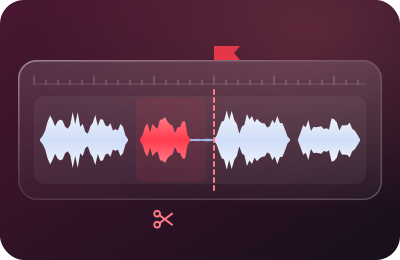
This site is named for a broadcasting idea — the narrow cast, one voice to a specific audience — but our house obsession is narrower still: take one. Not because retakes are shameful, but because they're expensive in a currency nobody budgets: performance. Here is the complete method for narrating screencasts in one rolling pass.
Why retakes cost more than time
Run the experiment any narrator eventually runs by accident: record the same ninety-second explanation five times and play take one against take five. Take five is more accurate — and audibly worse. The energy has flattened into recitation. Your mouth has dried (you can hear it on the clicks). You've drifted two inches off your original mic distance, so the tone shifted. The heating cycled on somewhere around take three, so the noise floor changed mid-lesson. And because each take was a fresh file, you now have five almost-identical recordings to audition, which is its own tax. The notebook entry on take decay unpacks the why; this page is the how-to-never-need-it.
The retake-free method rests on one mechanical insight: a flubbed sentence does not require a new take — it requires the same sentence again, four seconds later. Everything below is scaffolding for that move.
Before the session: mark the script like a narrator, not a writer
- Write for the mouth. Read the script aloud once before recording anything, and rewrite every sentence you stumbled on — a stumble in rehearsal is a guaranteed flub under the red light. Shorter sentences aren't a style preference in narration; they're breath engineering.
- Mark your punch points. Put a visible mark (we use ¶) at every natural section seam — usually each paragraph or each on-screen action. These are your restart-from-here points: if anything goes wrong after a mark, you only ever re-speak back to the nearest one, never to the top.
- Underline the landmines. Product names, numbers, anything with a URL in it. Say each one aloud twice in warm-up. Fumbled proper nouns cause more retakes than nerves do.
- Warm up for ninety seconds. Read the first paragraph aloud twice — once flat and fast, once performed. You're not rehearsing content; you're waking the instrument and finding today's narration voice before the recorder rolls, so take one doesn't have to double as the warm-up.
During the session: the rolling protocol
- Slate the head. Two seconds: "Module three, take one." It timestamps the session for future-you, and it does something subtler — saying a slate out loud flips most people from reading mode into speaking mode. Cheap stagecraft, works anyway.
- When you flub: stop, breathe, beat, re-speak. Don't stop the recorder, don't sigh into the mic, don't editorialize ("ugh, again—"). Silence for one full breath, then re-speak from your nearest ¶ mark, at the same energy. The pause gives the edit a clean seam; the mark guarantees the re-speak overlaps a natural cut point.
- Keep rolling through everything. Doorbell, throat-clear, notification you forgot to silence: same protocol. One file per lesson, flubs and all, beats five clean-ish files every time — the audition tax disappears and the room stays acoustically consistent because the session never restarts.
- Match the distance. The one physical habit we'll preach: pick a mic distance at the slate and treat it as a contract for the session. Distance drift between a flub and its re-speak is what makes some punch-ins audible even with a perfect edit.
- Close with room tone. Thirty silent seconds before you stop — the raw material that makes every punch-in seam invisible. The full room-tone method, including why it must be captured through the same chain as the voice.
The edit this produces (and how little of it there is)
A retake-free session file edits almost mechanically: at every flub you'll see the same signature in the waveform — sentence, gap, sentence again. Keep the second, cut the first, let room tone breathe under the join. No auditioning takes, no hunting the "good version" across files. We stop there deliberately: how to perform cuts in any particular editor is its own craft with its own specialist guides, and this desk stays on the recording side of that line.
- Sentencethe take rolls on
- Cutthe flubbed line
- Gapone breath
- Keepthe same sentence again
- Room tonerecorded at the tail, laid under the join
Scripted, outlined, or improvised?
The method flexes across all three, but the flub economics differ. Full scripts produce the fewest flubs per minute and suit dense course lessons. Outlines (bullet points, spoken freely) produce more restarts but better warmth — mark your ¶ points between bullets and hold the same protocol. Pure improvisation over a live screen demo is the flub factory; if you improvise, improvise structure ("I'll explain this screen in three beats") so your punch points exist even without a script. For demo-heavy lessons, the hybrid we keep coming back to is the scratch track: mumble a fast, throwaway narration while you capture the screen actions, then record the real voiceover afterwards against the finished picture — with every advantage this page just gave you.
When a real retake is the honest call
- The read is wrong, not the words. If you got to the end and the whole lesson sounds tired, no edit fixes energy. Stand up, water, come back — and re-record tomorrow if you can; day-two take one beats day-one take six.
- The room changed mid-take. If the noise floor audibly shifted (construction started, rain arrived), a punch-in will never match across the divide. Finish the thought, note the timestamp, restart the session when the room settles.
- The content changed. Software UIs move; when the screen no longer matches the words, that's a revision, not a retake — and if you kept narration on its own track and captured tone, revisions cost minutes. This is why the method and the recording-side signal chain are one discipline, not two.
The quiet dependency: your noise floor
One-pass narration assumes the take is worth keeping, and nothing disqualifies a take faster than the room arriving with it. The method's silent partner is a capture chain that keeps noise out of the file — OBS's live filter if you record there (free, our standing no-commission pick), or a system layer under Loom, Camtasia and ScreenFlow. Solve that once and "say it once, ship it" stops being a slogan and becomes your default outcome. Run the whole ritual — marks, levels, slate, tone — from the ninety-second pre-REC checklist.